


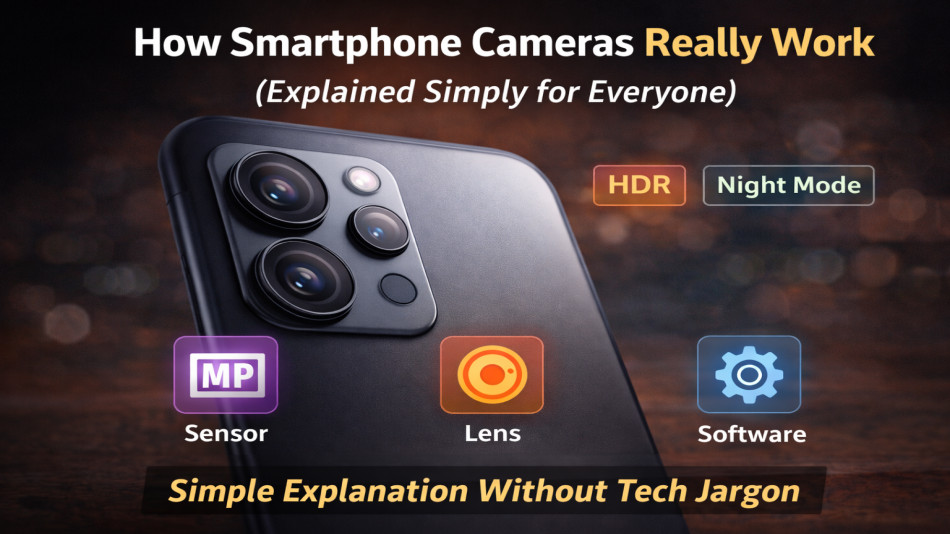
Smartphone camera have become incredibly powerful. Today, people take professional-looking photos using a device that fits in their pocket. But when brands talk about 108MP cameras, AI photography, or computational imaging, most users feel confused.
So let’s break it down.
This guide explains how smartphone cameras actually work, in a simple and human way — no technical jargon, no marketing hype.
The Basic Idea Behind a Smartphone Camera
At its core, a smartphone camera does just one thing:
👉 It captures light and turns it into a photo.
Every photo you take depends on how much light the camera collects and how well it processes that light.
Three main parts work together:
-
Sensor
-
Lens
-
Software
If any one of these is weak, photo quality suffers.
1. The Camera Sensor: The Heart of the Camera
The sensor is the most important part of any camera.
Think of the sensor as:
A digital sheet that catches light
What does the sensor do?
-
It receives light from the lens
-
Converts light into electrical signals
-
Sends data to the phone’s processor
Why sensor size matters
A larger sensor:
-
Captures more light
-
Produces clearer photos
-
Performs better in low light
This is why some phones with fewer megapixels still take better photos — their sensors are larger and more efficient.
Megapixels Explained (The Truth)
Megapixels are often misunderstood.
What is a megapixel?
One megapixel equals one million pixels.
More megapixels mean:
-
More image detail
-
Larger photo size
But here’s the truth 👇
Megapixels alone do not decide photo quality.
A 48MP camera with a good sensor can beat a 108MP camera with a small, poor sensor.
Pixel Size: The Hidden Hero in Smartphone Camera
Each pixel on the sensor captures light.
-
Larger pixels = more light
-
More light = better photos
Many phones use a technique called pixel binning, where:
-
Multiple small pixels combine into one large pixel
-
This improves brightness and detail in low light
That’s why 48MP or 64MP cameras often output 12MP photos.
2. The Lens: How Light Enters the Camera
The lens controls how light reaches the sensor.
Key things lenses affect:
-
Sharpness
-
Focus
-
Amount of light
-
Image distortion
Aperture (f-number) explained simply
Aperture controls how wide the lens opens.
-
Lower f-number (f/1.8) → more light
-
Higher f-number (f/2.4) → less light
Phones with wider apertures perform better in:
-
Low light
-
Night photography
-
Indoor shots
Why Smartphone Lenses Are Fixed
Unlike DSLR cameras, phone lenses don’t zoom physically (in most cases).
Why?
-
Space limitations
-
Thin phone design
-
Mechanical complexity
Instead, phones use:
-
Multiple lenses
-
Digital zoom
-
AI enhancements
3. Software: The Real Magic Behind Photos in Smartphone Camera
This is where smartphones shine.
Modern phone cameras rely heavily on software and AI to improve images.
What software does:
-
Adjusts brightness and contrast
-
Reduces noise
-
Enhances colours
-
Sharpens details
-
Fixes exposure problems
Your phone processes photos in milliseconds before you even see them.
HDR Explained Simply in Smartphone Camera
HDR stands for High Dynamic Range.
When you take a photo:
-
One image captures shadows
-
Another captures highlights
-
Software merges them into one balanced photo
This helps when:
-
Sky is bright
-
Subject is dark
HDR prevents washed-out skies and dark faces.
Night Mode: How Phones See in the Dark
Night Mode doesn’t magically create light.
Instead, it:
-
Takes multiple photos
-
Uses longer exposure
-
Combines them into one image
-
Reduces noise using AI
That’s why you’re asked to keep your phone still during Night Mode.
Image Stabilization in Smartphone Camera: Keeping Photos Sharp
Shaky hands cause blurry photos.
Phones solve this using:
-
OIS (Optical Image Stabilization)
-
EIS (Electronic Image Stabilization)
OIS
-
Physically stabilizes the lens
-
Best for photos and videos
EIS
-
Uses software
-
Crops and adjusts frames
-
Works well for video
Many phones use both together.
Multiple Cameras: Why Phones Have So Many Lenses
Most smartphones now have:
-
Main camera
-
Ultra-wide camera
-
Macro camera
-
Telephoto camera
Each lens serves a different purpose.
Main camera
-
Best quality
-
Used most of the time
Ultra-wide
-
Wider field of view
-
Landscapes and group photos
Telephoto
-
Optical zoom
-
Better portrait shots
Macro
-
Extreme close-ups
More cameras don’t always mean better quality — quality depends on how well they’re used.
Portrait Mode Explained of Smartphone Camera
Portrait Mode creates background blur.
How?
-
Software separates subject from background
-
Applies artificial blur
-
Simulates DSLR-like depth
Phones with telephoto lenses do this better, but AI plays the biggest role.
Front Smartphone Camera: Why Selfies Look Different
Front cameras:
-
Have smaller sensors
-
Use more software processing
-
Often apply beauty effects
That’s why selfies may look smoother than reality.
Why Photos Look Different on Different Phones
Two phones can take the same photo and still look different.
Why?
-
Different sensors
-
Different lenses
-
Different colour tuning
-
Different software processing
Some brands prefer:
-
Natural colours
Others prefer: -
Bright and punchy photos
Neither is “wrong” — it’s preference.
Video Recording: More Than Just Resolution
Video quality depends on:
-
Stabilization
-
Frame rate
-
Processing
-
Audio recording
A 4K video isn’t useful if it’s shaky or poorly stabilised.
Common Camera Myths (Busted)
❌ More megapixels = better camera
❌ AI means fake photos
❌ Night Mode works without light
❌ More lenses always mean better quality
Truth:
👉 Balance matters more than specs.
How to Take Better Photos With Any Phone
You don’t need a flagship phone to take good photos.
Simple tips:
-
Clean the lens
-
Use proper lighting
-
Hold phone steady
-
Don’t overuse zoom
-
Understand your camera modes
Final Verdict: How Smartphone Camera Really Works
Smartphone cameras aren’t magic — they’re smart systems.
Great photos come from:
-
Good sensors
-
Decent lenses
-
Powerful software
-
Smart processing
Instead of focusing on megapixels, focus on overall camera balance.
Bottom Line
Your smartphone camera is a powerful mini-computer that captures light, processes it instantly, and delivers beautiful photos — all in your pocket.
Some Hot Deals On Smartphone Camera
Affiliate Disclosure:In obedience to the Federal Trade Commission’s guide (FTC), and to avoid any misinterpretation of our visitors on freefundas.in, it is to inform you that we may earn some commission at no extra cost to you(the visitor) when you(the visitor) buy any of the services or products listed on our website like mobile phones, Gadgets, Laptops, etc. from their merchant as there are Affiliate Links also in the Article.