


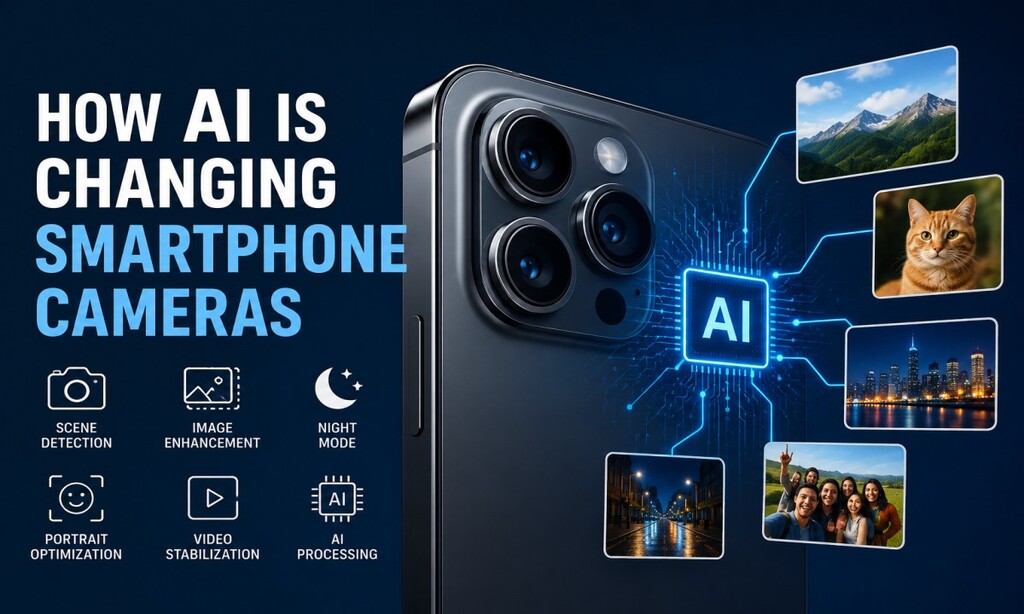
How AI In Smartphone cameras have improved dramatically over the last few years. Today, even mid-range phones can capture photos that once required expensive DSLR cameras.
But surprisingly, the biggest reason behind this improvement is not just better hardware.
👉 It’s Artificial Intelligence (AI).
Modern smartphone photography is now heavily powered by AI, from portrait shots and night photography to video stabilization and scene optimization.
But how exactly does AI change smartphone cameras?
And is it genuinely useful or just another marketing buzzword?
Let’s break it down in simple language.
What Does AI in Smartphone Cameras Actually Mean?
AI in smartphone cameras refers to software algorithms that help phones:
- Understand scenes
- Improve image quality
- Adjust settings automatically
- Process photos intelligently
Instead of relying only on camera hardware, phones now use machine learning and computational photography to enhance images.
In simple terms:
👉 AI helps your phone “think” before capturing a photo.
Why Smartphone Cameras Need AI
Smartphones have one major limitation:
👉 Small camera sensors.
Unlike professional cameras, phones don’t have large lenses or huge sensors. So brands use AI to compensate for hardware limitations.
AI helps phones:
- Capture more detail
- Improve lighting
- Reduce blur
- Enhance colors
Without AI, smartphone photos would look much less impressive.
1. AI Scene Detection
This is one of the most common AI camera features.
Your phone automatically recognizes:
- Food
- Pets
- Landscapes
- Faces
- Night scenes
Then it adjusts settings instantly.
For example:
- Food → boosts colors
- Sky → improves contrast
- Portrait → softens background
Is it useful?
Yes, especially for casual users who just want quick good-looking photos.
2. AI Night Photography
Night photography is one area where AI has completely changed smartphone cameras.
Modern phones now combine:
- Multiple exposures
- Noise reduction
- AI processing
This allows phones to capture brighter and clearer night photos.
Years ago, smartphone night shots looked blurry and noisy. Today, AI helps phones produce surprisingly sharp low-light images.
3. AI In Smartphone Portrait Mode
Portrait mode is another feature powered heavily by AI.
The phone uses AI to:
- Detect subjects
- Separate background
- Add blur effect
This creates DSLR-like portrait photos.
Modern AI portrait systems are now better at:
- Hair detection
- Edge separation
- Skin tone processing
4. AI Video Stabilization
AI also improves video quality significantly.
Phones now use AI for:
- Motion stabilization
- Object tracking
- Background blur in videos
- Frame optimization
This helps videos look smoother even when recording while walking.
5. AI Beauty Filters and Skin Processing
Almost every smartphone brand now includes AI beauty enhancements.
These features:
- Smooth skin
- Brighten faces
- Adjust facial features
Some users love these effects, while others prefer more natural-looking photos.
6. AI Image Processing
One of the biggest changes in smartphone photography is computational photography.
Instead of capturing a single photo, phones now capture multiple images instantly and combine them using AI.
This improves:
- Dynamic range
- Sharpness
- Colors
- Exposure balance
This is why modern smartphone photos often look more detailed than older devices.
AI vs Megapixels: What Matters More?
Many people still believe:
👉 More megapixels = better camera
But in reality:
👉 AI processing often matters more.
A well-optimized 50MP camera with strong AI can outperform a poorly optimized 200MP sensor.
That’s because software now plays a massive role in photography.
How AI In Smartphone Improves Everyday Photography
AI helps regular users take better photos without understanding camera settings.
It automatically handles:
- Lighting
- Focus
- Exposure
- Color tuning
This makes smartphone photography much easier for beginners.
Is AI In Smartphone Making Photos “Fake”?
This is a growing debate.
Some users feel AI processing:
- Oversaturates colors
- Sharpens faces too much
- Makes images look unrealistic
In some cases, AI enhances photos so heavily that they no longer represent what the scene actually looked like.
So while AI improves image quality, it can sometimes reduce natural realism.
Which Smartphone Brands Use AI Best?
Different brands focus on different AI strengths.
Samsung AI In Smartphone
Known for:
- Scene optimization
- Zoom AI
- Bright, vibrant photos
Apple
Focuses on:
- Natural image processing
- Video optimization
- Smart HDR
Google Pixel
Famous for:
- Computational photography
- AI-powered image processing
- Realistic photos
Vivo & Oppo
Strong in:
- Portrait AI
- Night photography
- Beauty enhancements
AI and Battery Consumption
AI camera processing is powerful, but it also requires more processing power.
This can:
- Increase battery usage
- Generate heat during long camera sessions
That’s why modern flagship phones now use dedicated AI chips and image processors.
The Future of AI in Smartphone Cameras
AI camera technology is evolving very quickly.
Future smartphones may include:
- Real-time object removal
- Advanced AI zoom
- AI-generated backgrounds
- Better motion capture
- Smarter video editing
Some phones are already experimenting with AI-generated image enhancements.
The Downsides of AI Camera Technology
AI is impressive, but it’s not perfect.
❌ Overprocessing
Photos can sometimes look:
- Too sharp
- Too bright
- Unrealistic
❌ Privacy Concerns
AI analyzes:
- Faces
- Objects
- Scenes
This raises questions about how image data is processed and stored.
❌ Inconsistent Results
Sometimes AI processing changes images too aggressively depending on lighting conditions.
Real Talk: Is AI Actually Important in Smartphone Cameras?
Honestly?
👉 Yes — but mostly in the background.
The best AI features are the ones you barely notice.
AI has made smartphone cameras:
- Easier to use
- More consistent
- Better in difficult conditions
But hardware still matters too.
The best camera phones combine:
✅ Strong sensors
✅ Good lenses
✅ Smart AI processing
🏁 Final Verdict
AI has completely transformed smartphone photography. It allows phones with small sensors to capture surprisingly impressive photos and videos.
From night mode and portrait photography to video stabilization and scene optimization, AI now powers many of the camera features people use every day.
At the same time, brands sometimes overuse “AI” as a marketing term for ordinary software effects.
✅ Bottom Line
AI is genuinely improving smartphone cameras — especially for everyday users who want great photos without learning professional photography.
The future of smartphone cameras will depend not only on hardware but also on how intelligently AI can process and enhance images.
✍️ Author
Written by Anurag Chaubey
Tech writer at Freefundas.in, focused on smartphone technology, AI trends, and practical consumer tech guides.