


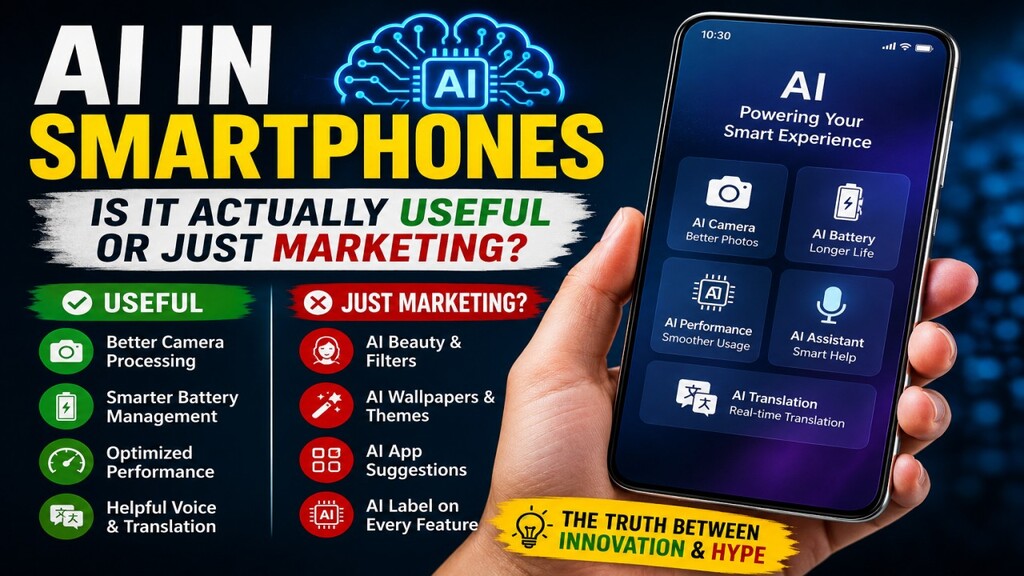
AI in Smartphones:
Artificial Intelligence, or AI, has become one of the biggest buzzwords in the smartphone industry. Every major brand now talks about “AI-powered features” during launches and advertisements.
From AI cameras to AI battery optimization and AI assistants, companies are promoting smartphones as smarter than ever before.
But this raises an important question:
👉 Is AI in smartphones genuinely useful, or is it mostly marketing hype?
The truth lies somewhere in the middle.
Some AI features truly improve everyday smartphone usage, while others exist mainly to impress buyers with flashy terms. In this article, we’ll break everything down in simple language so you can understand what AI actually does inside modern smartphones and whether it really matters.
🧠 What Does AI in Smartphones Actually Mean?
When brands say a phone has “AI features,” they usually mean the device uses software algorithms and machine learning to improve tasks automatically.
In simple words:
👉 AI helps your phone learn patterns and make certain tasks smarter or faster.
Instead of manually adjusting everything, the phone tries to predict what you need.
📱 Where AI Is Used in Smartphones
AI is now integrated into almost every part of a modern smartphone.
📸 1. AI Cameras (Most Common Use)
This is probably the biggest area where AI is used.
Modern smartphone cameras use AI to:
- Detect scenes automatically
- Improve lighting
- Adjust colors
- Enhance portraits
- Reduce noise in night photos
For example:
- If you point your camera at food, AI may increase saturation.
- If it detects a face, it may soften skin tones automatically.
✅ Is it useful?
Yes — especially for casual users.
AI allows people to capture better-looking photos without understanding professional photography.
🔋 2. AI Battery Optimization
Many phones now claim to use AI for battery management.
What it actually does:
- Learns your charging habits
- Restricts unused background apps
- Optimizes power consumption
Some phones even slow charging overnight and finish charging just before you wake up to protect battery health.
✅ Is it useful?
Mostly yes.
Battery optimization powered by AI can genuinely improve battery life and reduce unnecessary drain.
⚡ 3. AI Performance Optimization
Smartphones now use AI to:
- Allocate resources dynamically
- Predict which apps you’ll open next
- Improve gaming performance
This helps phones feel smoother during daily usage.
✅ Is it useful?
Moderately useful.
You may not always notice it directly, but it improves overall responsiveness.
🎙️ 4. Voice Assistants and AI Chat Features
AI powers:
- Google Assistant
- Siri
- Real-time translation
- Voice typing
- AI chat tools
Modern AI assistants can:
- Understand natural language
- Answer questions
- Summarize text
- Generate content
✅ Is it useful?
Yes, especially for productivity and accessibility.
🌐 5. AI Translation and Communication
Some smartphones now offer:
- Live call translation
- AI subtitles
- Real-time transcription
These features are becoming increasingly useful in multilingual countries like India.
✅ Is it useful?
Absolutely.
This is one area where AI genuinely improves communication.
🤔 So… Is AI Actually Useful?
The honest answer:
👉 Some AI features are genuinely helpful.
👉 Others are mostly marketing.
Let’s separate reality from hype.
✅ AI Features That Are Actually Useful
These features genuinely improve smartphone experience:
✔ AI camera processing
✔ Battery optimization
✔ Voice typing
✔ Real-time translation
✔ Spam call detection
✔ Photo editing tools
These solve real problems and save time.
❌ AI Features That Feel Like Marketing
Some AI features exist mainly to attract attention during launches.
Examples:
- “AI beauty enhancement”
- AI wallpapers
- AI app suggestions you never use
- Overprocessed AI camera effects
Many brands add “AI” to ordinary software features because it sounds futuristic.
📊 Why Smartphone Brands Push AI So Much
AI has become the new selling point because:
- Hardware improvements are slowing down
- Most flagship phones already feel fast
- Camera quality is already very good
So companies now use AI to make devices feel “next-generation.”
👉 In many cases, AI is more about differentiation than necessity.
🧠 Real-World Examples of Useful AI In Smartphones
Let’s look at situations where AI genuinely helps:
📸 Photography
AI improves:
- Portrait mode
- Night mode
- Object detection
Without AI, smartphone cameras would struggle to compete with DSLRs.
🔋 Battery Life
AI learns:
- Which apps you rarely use
- Your charging schedule
This helps extend battery life over time.
📝 Productivity of AI in smartphones
AI can:
- Summarize notes
- Translate text instantly
- Improve voice typing accuracy
These features are genuinely practical.
⚠️ The Downsides of AI in Smartphones
AI isn’t perfect.
🔻 1. Overprocessing in Photos
Sometimes AI:
- Makes photos look unnatural
- Oversharpens faces
- Adds unrealistic colors
Many users now prefer more natural-looking photos.
🔻 2. Privacy Concerns
AI often analyzes:
- Your usage habits
- Photos
- Voice commands
This raises questions about data privacy.
🔻 3. Battery Consumption
Ironically, some AI features also consume extra battery and processing power.
🧠 Real Talk: Do You Need AI in Smartphone?
Here’s the truth most brands won’t tell you:
👉 You already use AI daily without noticing it.
Features like:
- Camera enhancement
- Autocorrect
- Face unlock
- Voice typing
…are all powered by AI.
But you don’t necessarily need “advanced AI features” to enjoy a good smartphone experience.
📱 Should AI Affect Your Buying Decision?
AI should not be the ONLY reason to buy a phone.
Instead, focus on:
- Battery life
- Processor
- Software quality
- Camera consistency
- Long-term updates
AI is a bonus — not the main foundation.
🚀 The Future of AI in Smartphones
AI will become even more important in coming years.
Future smartphones may offer:
- Smarter personal assistants
- Better language translation
- Advanced image editing
- More personalized experiences
The goal is simple:
👉 Make phones feel more intelligent and adaptive.
🏁 Final Verdict
AI in smartphones is neither completely useless nor completely revolutionary.
Some AI features genuinely improve:
- Photography
- Battery life
- Productivity
- Communication
At the same time, many brands use “AI” mainly as a marketing term to make ordinary features sound futuristic.
✅ Bottom Line
AI is most useful when it solves real problems quietly in the background—not when it’s used just for advertising.
The best smartphone isn’t the one with the most AI features.
It’s the one that gives you the best overall experience.
✍️ Author
Written by Anurag Chaubey
Tech writer at Freefundas.in, focused on practical smartphone insights and real-world technology guides.